The origin of war
It was born of instinct, perfected by culture, and legitimized by reason. Organized violence has accompanied humanity since before its first civilization, and it continues to be present today as a shadow of our intelligence: are we destined to attack each other?
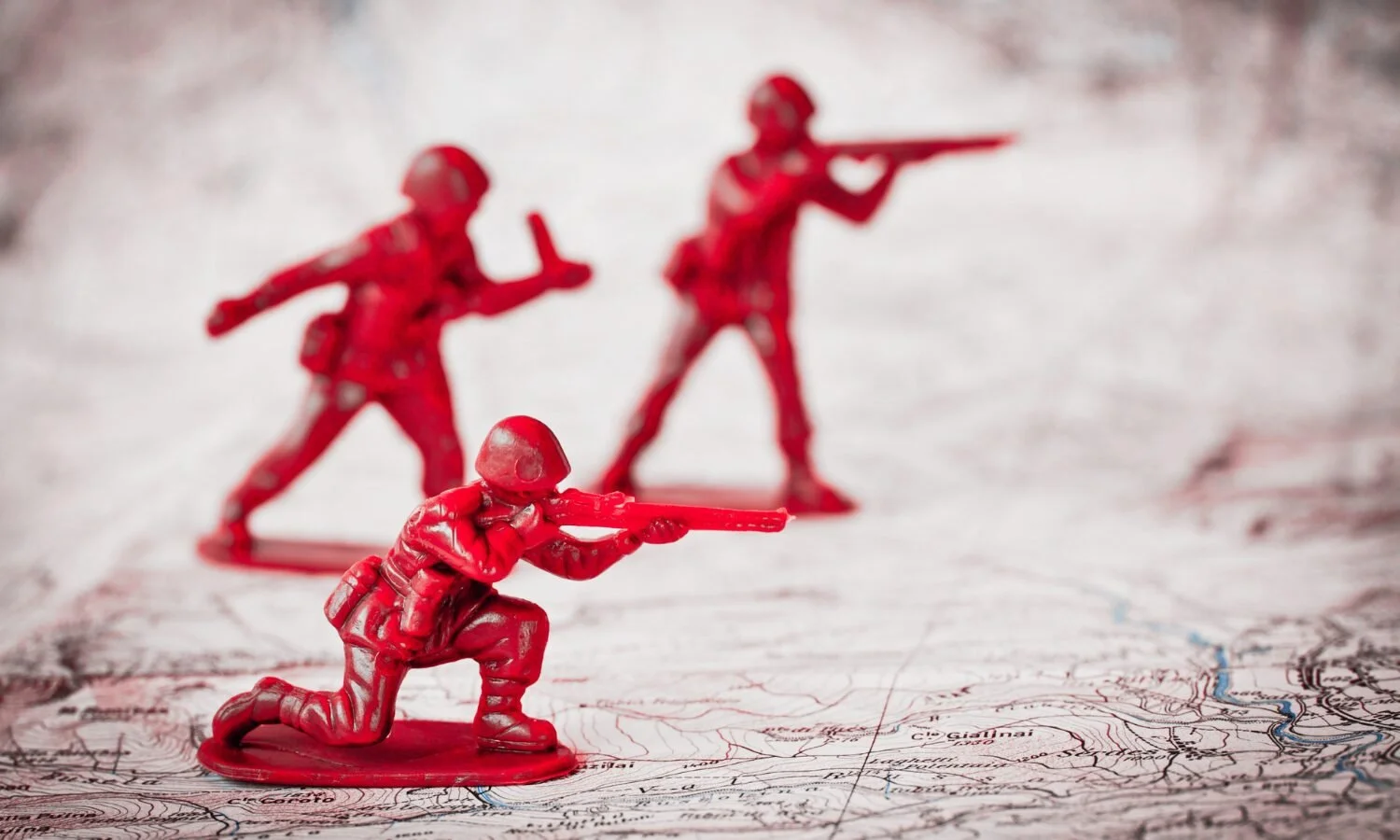
The history of war is not a straight line connecting point A—wooden clubs—to point B—drones. It is not a linear reflection of human evolution, but an interactive tangle of instinct, intelligence, and serendipity. Any of our ancestors, long before nations established borders and before there were captains-general, were already practicing forms of organized violence. However, the question is as old as philosophy itself: Is war part of human nature?
Some academics argue that conflict between groups is a product of adaptive pressures inherent in survival and competition for resources. In other words, they advocate for a genetic component. This argument is based on observations of chimpanzees, close relatives of humans, which show that coalitions of males carry out lethal raids against neighboring groups, killing their "rivals" and annexing their territory. These behaviors are not spontaneous expressions of aggression, but rather planned, coordinated, and carried out collectively, suggesting that strategic violence and territorial defense may have been present millions of years before the emergence of Homo sapiens.
Other researchers argue that war is a relatively recent sociopolitical invention, associated with the rise of agriculture and the formation of states. For example, they point out that while chimpanzees do fight in groups, bonobos (who are also close relatives of humans) resolve tension through bonding, play, and even sexual reconciliation. The existence of this duality among animals suggests that evolution did not endow us with a single destiny, but rather with a range of social possibilities. They maintain that context, rather than genetics, inclines us toward peace or conflict.
Some sites, such as Nataruk in Kenya, reveal scenes of mass killings dating back some 10,000 years. Twenty-seven skeletons were found there with bones pierced by blades and stone points. Jebel Sahaba in Sudan preserves the remains of hunter-gatherers who suffered a similar fate. Such findings suggest that small-scale massacres may have preceded the agricultural era. However, they are quite rare.
That changed with the Neolithic Revolution, when humans began to settle down, cultivate crops, and accumulate resources. Sedentary life brought population growth and wealth, but also inequality, hierarchy, and competition. The archaeological record from this period shows a clear increase in violence: fortified villages, walls, and organized armies appear. The transition from nomadic gatherers to sedentary farmers, therefore, may have transformed sporadic raids into long-term warfare. This could indicate that, although the biological capacity for aggression is ancient, war as a social system appears to be a cultural creation, a structured response to the problems of property, power, and ideology.
Centuries later, civilization did not eliminate war; it transformed it. Kings and priests sacralized it, states professionalized it, and propaganda gave it moral meaning. Thus, killing for one's country or for the gods became a virtue, and those cognitive skills that had allowed for cooperation in hunting were employed for conquest. Instinct became doctrine.
However, throughout history, ethical systems also emerged that attempted to tame violence to some extent. Buddhism, Christianity, and humanism, among many others, tried to defend compassion and self-control. Over time, social and political progress, from law to education, reduced the frequency of interpersonal violence. Today, although it still persists, war is no longer a vital necessity, but an institutional choice.
In response to the initial question, one could say that war relies on ancient biological mechanisms, such as fear, belonging, and hierarchy. But it is not written in our genes. It is a possibility that culture can activate or suppress. Therefore, war is not our destiny, but one of our choices. It is a script that is triggered when fear and ideology overshadow empathy. As Margaret Mead wrote, "War is just an invention, an invention like any other." If this is true, then peace could also be invented.